KV Store Persistence
The EDK extends the IDK's KvStore abstraction with database-backed implementations. Store key-value data in PostgreSQL, MySQL, or SQLite with full multi-tenant and multi-scope isolation.
Overview
The database KV store provides:
- Multi-dialect support - PostgreSQL, MySQL, SQLite backends
- Multi-scope isolation - APP, TENANT, PRINCIPAL, SESSION partitioning
- TTL support - Automatic expiration of entries
- Namespace isolation - Type-safe namespaces with codecs
- IDK compatibility - Implements the same
KvStoreinterface
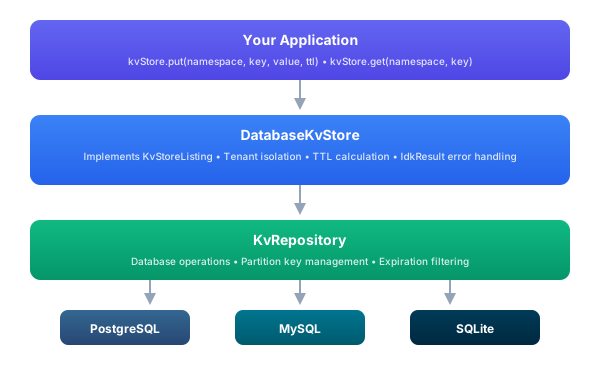
Architecture
The database KV store implements the IDK's KvStoreListing interface:
Data Model
KvEntryEntity
Each key-value entry is stored as:
data class KvEntryEntity(
    val id: String,              // Unique entry ID
    val storeId: String,         // KV store identifier
    val tenantId: String,        // Tenant isolation
    val principalId: String?,    // User isolation (null for APP/TENANT)
    val sessionId: String?,      // Session isolation (null except SESSION scope)
    val namespace: String,       // Namespace isolation
    val key: String,             // Key within namespace
    val value: ByteArray,        // Serialized value
    val expiresAt: Instant?,     // Expiration time (null = never)
    val createdAt: Instant,
    val updatedAt: Instant
)
Partition Key Structure
The partition key provides multi-level isolation:
| Scope | Partition Key Components |
|---|---|
| APP | (storeId, tenantId, null, null, namespace, key) |
| TENANT | (storeId, tenantId, null, null, namespace, key) |
| PRINCIPAL | (storeId, tenantId, principalId, null, namespace, key) |
| SESSION | (storeId, tenantId, principalId, sessionId, namespace, key) |
Repository Interface
KvRepository
The core repository interface:
interface KvRepository {
    // Read operations
    suspend fun findEntry(
        storeId: String,
        tenantId: String,
        principalId: String?,
        sessionId: String?,
        namespace: String,
        key: String
    ): KvEntryEntity?  // Returns null if expired or not found

    suspend fun existsEntry(
        storeId: String,
        tenantId: String,
        principalId: String?,
        sessionId: String?,
        namespace: String,
        key: String
    ): Boolean  // Excludes expired entries

    suspend fun listKeys(
        storeId: String,
        tenantId: String,
        principalId: String?,
        sessionId: String?,
        namespace: String
    ): List<String>  // Non-expired keys only

    suspend fun findAllEntries(
        storeId: String,
        tenantId: String,
        principalId: String?,
        sessionId: String?,
        namespace: String
    ): List<KvEntryEntity>  // Non-expired entries only

    // Write operations
    suspend fun upsertEntry(entity: KvEntryEntity)

    suspend fun deleteEntry(
        storeId: String,
        tenantId: String,
        principalId: String?,
        sessionId: String?,
        namespace: String,
        key: String
    ): Boolean  // Returns true if entry was deleted

    suspend fun touchEntry(
        storeId: String,
        tenantId: String,
        principalId: String?,
        sessionId: String?,
        namespace: String,
        key: String,
        newExpiresAt: Instant?
    ): Boolean  // Update TTL without changing value

    // Maintenance
    suspend fun cleanupExpired(namespace: String?): Int  // Returns count deleted
}
DatabaseKvStore
The main KV store implementation:
class DatabaseKvStore(
    private val config: KvStoreConfig,
    private val repositoryProvider: () -> KvRepository,
    private val partitionKey: PartitionKey  // Contains scope identifiers
) : KvStoreListing {

    override suspend fun <V : Any> put(
        namespace: KvNamespace<V>,
        key: String,
        value: V,
        ttl: Duration
    ): IdkResult<KvPutResult, IdkError> {
        return try {
            val encoded = namespace.codec.encode(value)
            val expiresAt = if (ttl.isInfinite()) null
                           else Clock.System.now() + ttl

            val entity = KvEntryEntity(
                id = UUID.randomUUID().toString(),
                storeId = config.id,
                tenantId = partitionKey.tenantId,
                principalId = partitionKey.principalId,
                sessionId = partitionKey.sessionId,
                namespace = namespace.name,
                key = key,
                value = encoded,
                expiresAt = expiresAt,
                createdAt = Clock.System.now(),
                updatedAt = Clock.System.now()
            )

            repository.upsertEntry(entity)

            Ok(KvPutResult(
                metadata = KvEntryMetadata(
                    createdAtEpochMillis = entity.createdAt.toEpochMilliseconds(),
                    expiresAtEpochMillis = entity.expiresAt?.toEpochMilliseconds()
                )
            ))
        } catch (e: Exception) {
            Err(IdkError(
                code = "KV_PUT_FAILED",
                message = IdkError.Message(
                    i18nKey = "com.sphereon.kv.error.put-failed",
                    defaultMessage = "Failed to store value: ${e.message}"
                )
            ))
        }
    }

    override suspend fun <V : Any> get(
        namespace: KvNamespace<V>,
        key: String
    ): IdkResult<V?, IdkError> {
        return try {
            val entity = repository.findEntry(
                storeId = config.id,
                tenantId = partitionKey.tenantId,
                principalId = partitionKey.principalId,
                sessionId = partitionKey.sessionId,
                namespace = namespace.name,
                key = key
            )

            if (entity == null) {
                Ok(null)
            } else {
                val decoded = namespace.codec.decode(entity.value)
                Ok(decoded)
            }
        } catch (e: Exception) {
            Err(IdkError(code = "KV_GET_FAILED", ...))
        }
    }

    // ... other KvStore methods
}
Usage Examples
Basic Operations
import com.sphereon.data.store.kv.*
import kotlinx.serialization.Serializable
import kotlin.time.Duration.Companion.hours

@Serializable
data class CacheEntry(
    val data: String,
    val cachedAt: Long
)

// Define a namespace with JSON codec
val cacheNamespace = KvNamespace(
    name = "api.cache",
    codec = KotlinxSerializationJsonKvCodec(
        json = Json { ignoreUnknownKeys = true },
        serializer = CacheEntry.serializer()
    )
)

// Store a value with TTL
val result = kvStore.put(
    namespace = cacheNamespace,
    key = "user-profile-123",
    value = CacheEntry(
        data = """{"name": "Alice"}""",
        cachedAt = System.currentTimeMillis()
    ),
    ttl = 1.hours
)

when (result) {
    is IdkResult.Success -> {
        println("Stored, expires at: ${result.value.metadata.expiresAtEpochMillis}")
    }
    is IdkResult.Failure -> {
        println("Failed: ${result.error.message}")
    }
}

// Retrieve the value
val getResult = kvStore.get(cacheNamespace, "user-profile-123")

when (getResult) {
    is IdkResult.Success -> {
        val entry = getResult.value
        if (entry != null) {
            println("Cached data: ${entry.data}")
        } else {
            println("Not found or expired")
        }
    }
    is IdkResult.Failure -> {
        println("Error: ${getResult.error}")
    }
}
Multi-Tenant Usage
@Singleton
class TenantCacheService @Inject constructor(
    private val kvStoreService: KvStoreService
) {
    private val cacheNamespace = KvNamespace(
        name = "tenant.cache",
        codec = StringKvCodec()
    )

    suspend fun getCachedValue(tenantId: String, key: String): String? {
        // Get tenant-scoped KV store
        val store = kvStoreService.getStoreForTenant(tenantId)

        return store.get(cacheNamespace, key)
            .getOrNull()
    }

    suspend fun setCachedValue(tenantId: String, key: String, value: String, ttl: Duration) {
        val store = kvStoreService.getStoreForTenant(tenantId)

        store.put(cacheNamespace, key, value, ttl)
            .getOrThrow()
    }
}
Session-Scoped Storage
@Singleton
class SessionDataService @Inject constructor(
    private val kvStoreService: KvStoreService
) {
    private val sessionNamespace = KvNamespace(
        name = "session.data",
        codec = KotlinxSerializationJsonKvCodec(
            json = Json,
            serializer = SessionData.serializer()
        )
    )

    suspend fun getSessionData(sessionId: String): SessionData? {
        // Get session-scoped KV store
        val store = kvStoreService.getStoreForSession(sessionId)

        return store.get(sessionNamespace, "current")
            .getOrNull()
    }

    suspend fun setSessionData(sessionId: String, data: SessionData) {
        val store = kvStoreService.getStoreForSession(sessionId)

        // Session data expires with session (30 minutes)
        store.put(sessionNamespace, "current", data, 30.minutes)
            .getOrThrow()
    }
}
Listing and Cleanup
// List all keys in namespace
val keysResult = kvStore.listKeys(cacheNamespace)

when (keysResult) {
    is IdkResult.Success -> {
        keysResult.value.forEach { key ->
            println("Key: $key")
        }
    }
}

// Get all entries with metadata
val entriesResult = kvStore.getAllEntries(cacheNamespace)

when (entriesResult) {
    is IdkResult.Success -> {
        entriesResult.value.forEach { (key, entry) ->
            println("$key: ${entry.value}, expires: ${entry.metadata.expiresAtEpochMillis}")
        }
    }
}

// Clean up expired entries
val cleanupResult = kvStore.cleanupExpired(cacheNamespace)

when (cleanupResult) {
    is IdkResult.Success -> {
        println("Cleaned up ${cleanupResult.value} expired entries")
    }
}
Database Schema
PostgreSQL
CREATE TABLE kv_entry (
    id TEXT PRIMARY KEY,
    store_id TEXT NOT NULL,
    tenant_id TEXT NOT NULL,
    principal_id TEXT,
    session_id TEXT,
    namespace TEXT NOT NULL,
    key TEXT NOT NULL,
    value BYTEA NOT NULL,
    expires_at TIMESTAMP WITH TIME ZONE,
    created_at TIMESTAMP WITH TIME ZONE NOT NULL,
    updated_at TIMESTAMP WITH TIME ZONE NOT NULL,
    UNIQUE (store_id, tenant_id, principal_id, session_id, namespace, key)
);

CREATE INDEX idx_kv_entry_lookup ON kv_entry(store_id, tenant_id, principal_id, session_id, namespace);
CREATE INDEX idx_kv_entry_expires ON kv_entry(expires_at) WHERE expires_at IS NOT NULL;
MySQL
Uses DATETIME(6) for timestamps and BLOB for value storage.
SQLite
Uses TEXT for timestamps and BLOB for value storage.
Configuration
Backend Identifiers
object DatabaseKvStoreBackends {
    const val DATABASE = "database"      // Generic database backend
    const val POSTGRESQL = "postgresql"  // PostgreSQL-specific
    const val MYSQL = "mysql"            // MySQL-specific
    const val SQLITE = "sqlite"          // SQLite-specific
}
Store Configuration
val config = KvStoreConfig(
    id = "cache-store",
    scopeBinding = KvStoreScopeBinding.TENANT,  // Partition by tenant
    backendId = DatabaseKvStoreBackends.POSTGRESQL,
    enabled = true,
    order = 0
)
Properties Configuration
sphereon:
  kv:
    stores:
      cache:
        backend: postgresql
        scope-binding: TENANT
        enabled: true

      session:
        backend: postgresql
        scope-binding: SESSION
        enabled: true
Scope Bindings
| Binding | Partition By | Use Case |
|---|---|---|
APP | Application only | Global cache, feature flags |
TENANT | Tenant ID | Tenant-specific data |
PRINCIPAL_TENANT | Tenant + Principal | User data within tenant |
SESSION | Tenant + Principal + Session | Session-specific state |
Best Practices
Choose appropriate scope binding - Use the most restrictive scope that meets your needs for proper data isolation.
Set meaningful TTLs - Always set TTL for temporary data. Use Duration.INFINITE only for permanent data.
Run periodic cleanup - Schedule cleanupExpired() to remove expired entries if your database doesn't support automatic TTL enforcement.
Use typed namespaces - Define namespaces with proper codecs for type safety and consistent serialization.
Handle errors with IdkResult - All operations return IdkResult; handle both success and failure cases.
Monitor storage growth - Track namespace sizes and implement cleanup policies for high-volume stores.