OpenID for Verifiable Presentations (OpenID4VP)
The IDK already implements the full OpenID4VP verifier, the holder/wallet side, the DCQL query language, the Universal OID4VP API for backend integration, and a default in-memory DCQL store. The protocol details, request/response flows, JAR signing, JARM encryption, and the supported credential formats are documented in the IDK OpenID4VP guide; the EDK does not reshape any of that.
What the EDK adds is the production storage, transport, and lifecycle layer around it: a relational, version-history-preserving DCQL store with its own admin and history REST endpoints; a channel-to-DCQL authoring path that derives queries from the governed semantic model; a verifier-DCQL binding store (VDX) that lets multiple verifiers share a single tenant-scoped DCQL query at different pinned versions; scheduled future version activations driven by the EDK scheduler; routed-command transport for distributed deployments; and tenant-path-aware public verifier endpoints. This section covers those additions; protocol-level material stays in the IDK guide.
Requesting SD-JWT VC and mDoc
DCQL identifies the wire format explicitly. Use dc+sd-jwt with meta.vct_values for an SD-JWT VC and mso_mdoc with meta.doctype_value for an ISO mDoc. Claim paths are also format-specific: an SD-JWT claim is normally a short JSON path, while an mdoc claim includes its namespace, for example ["org.iso.18013.5.1", "family_name"].
| Format | DCQL discriminator | Verification-specific checks |
|---|---|---|
| SD-JWT VC | format: "dc+sd-jwt", meta.vct_values | Issuer signature, disclosures, vct, holder binding, issuer trust, and status |
| ISO mDoc | format: "mso_mdoc", meta.doctype_value | Issuer authentication, MSO validity, DSC/IACA chain, device authentication, namespace/element claims, issuer trust, and status |
Set require_cryptographic_holder_binding according to the relying-party policy. A DCQL query and a signed authorization request can be created through the backend API, but completion still requires a wallet to perform consent, device engagement, holder-key operations, and the final response callback. A Postman run proves the verifier session and request object; it cannot replace that wallet gate.
Trust sources remain distinct: an ETSI TS 119 602 JSON/JAdES list is a trusted-entity list for the applicable trust domain, while a VICAL is an ISO mdoc document-signer trust artifact. One must not be silently substituted for the other.
Verifier walkthrough surface
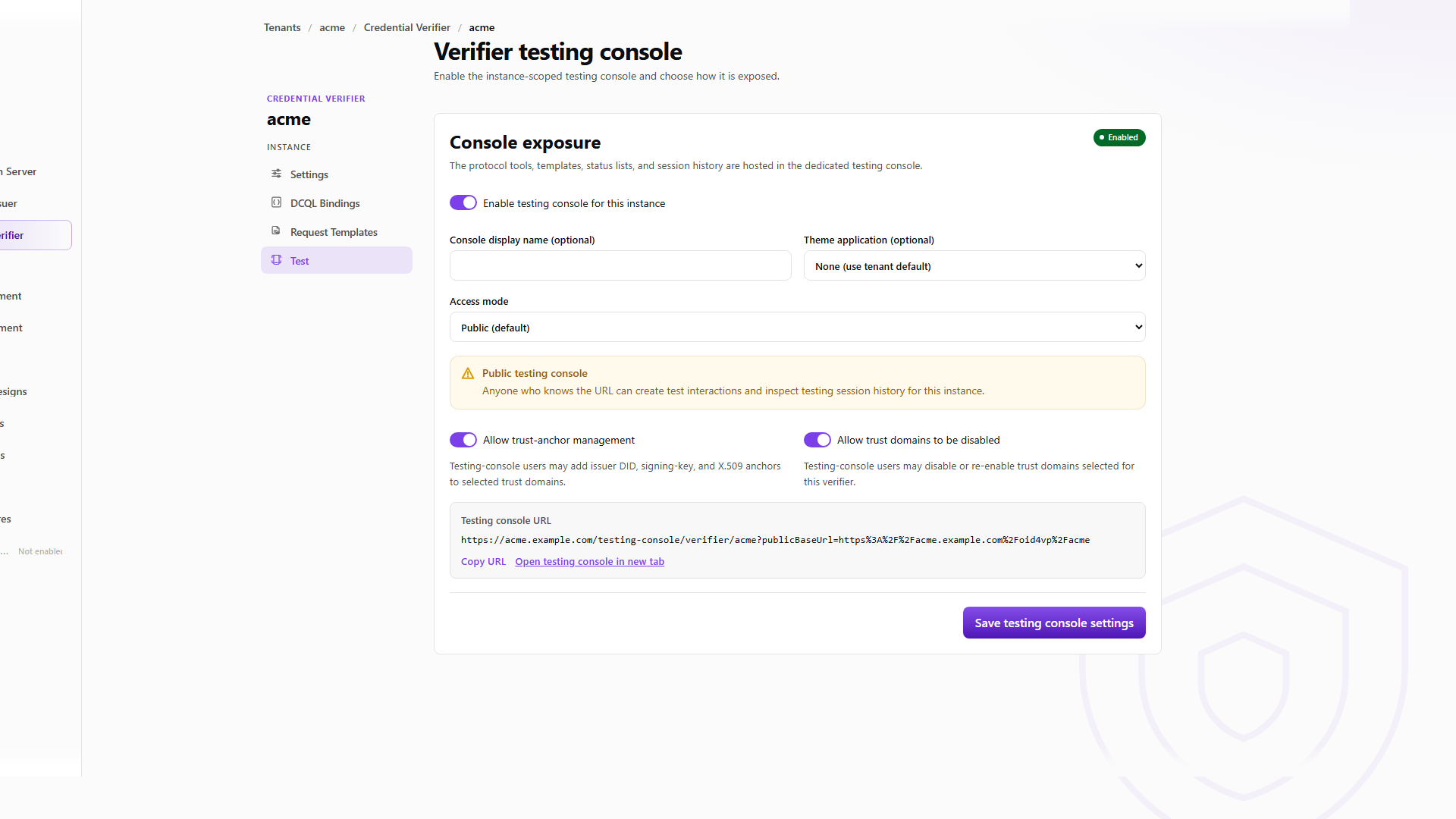
The public verifier testing console exposes the configured verification templates, DCQL presets, request-URI base, response endpoint, and current session counters. The following screenshot is an illustrative example; the wallet still has to complete consent, device engagement, holder-key operations, and the response callback.
What the EDK Adds
Versioned DCQL store. The IDK contract is DcqlQueryConfigurationStore, a key-value-ish CRUD interface with no concept of history. The EDK replaces it with VersionedDcqlQueryConfigurationStore, which honors the same contract but appends an immutable version row to a shared config_version table on every write and advances a current-version pointer in a typed dcql_query header table. Reads return the body that the current-version pointer references. The EDK adds listVersions, getVersion, and restoreVersion operations on top, and exposes them as REST endpoints at /api/v1/oid4vp/dcql/{queryId}/versions[/{version}[/restore]]. See DCQL Store.
Channel-to-DCQL authoring. Building a DCQL query by hand requires knowing credential formats, type identifiers, and claim paths. The EDK ships ChannelToDcqlConverter, which projects one or more version-pinned verifiable-credential channels into a complete DcqlQuery. Each channel contributes one credential query and carries the data-product selection, wire mappings, and credential identity that the projection needs. The preview operation returns the result without writing it; the authored operation persists a version and records REQUEST-role usage lineage. See DCQL Authoring.
Verifier-DCQL bindings (VDX). A tenant typically owns one DCQL query for a use case (age_verification, identity_check) but hosts multiple verifiers that each want to use that query at a specific pinned version. The VDX VerifierDcqlBinding is the (verifierId, dcqlQueryId, pinnedVersion) triple that captures that pin, with enabled and alias metadata. Two verifiers can bind the same query at different versions; rolling one verifier forward to a new DCQL version does not affect the others. Bindings have their own REST surface under /api/services/v1/oid4vp/verifiers/{verifierId}/dcql and a reverse-lookup endpoint at /api/v1/oid4vp/dcql/{queryId}/verifiers. See Verifier Bindings.
Scheduled activations. A verifier binding can also have a scheduled future activation: "at effectiveAt, repoint this binding from version 5 to version 7". The activation is a row in the EDK scheduler's scheduled_command table; the binding system projects pending activations as VerifierDcqlScheduledActivation records and lets operators list and cancel them. This is how regulated workflows move every verifier in a tenant to a new DCQL version on a known cutover date. Covered in Verifier Bindings.
Tenant-aware verifier paths. The public verifier endpoints (request_uri, direct_post) carry no bearer token, so the IDK resolves the tenant from the host header. The EDK adds the option of a leading path slug (/{tenantSlug}/oid4vp/request-uri/...) through TenantAwareOid4vpVerifierHttpAdapter, which tries an as-is match first and only falls back to slug lookup when no host match wins. Host-only deployments are unaffected.
Routed-command transport. Every IDK verifier, holder, universal, and common OID4VP command is wrapped in a generated *Routed class through the per-package RoutedCommandsSpec manifests (Oid4vpVerifierRoutedCommandsSpec, Oid4vpHolderRoutedCommandsSpec, UniversalOid4vpRoutedCommandsSpec, Oid4vpCommonRoutedCommandsSpec). A wallet, a verifier UI, or a backend integration can hold the IDK service interface and stay unaware that calls travel over HTTP RPC to a remote service. See the Command Transport guide.
Auth bridge. Wallet presentations can be translated into OAuth2/OIDC sessions through the EDK auth bridge, so a downstream service that expects a Bearer token can be fed by a wallet flow without speaking OpenID4VP itself.
How the Pieces Fit Together
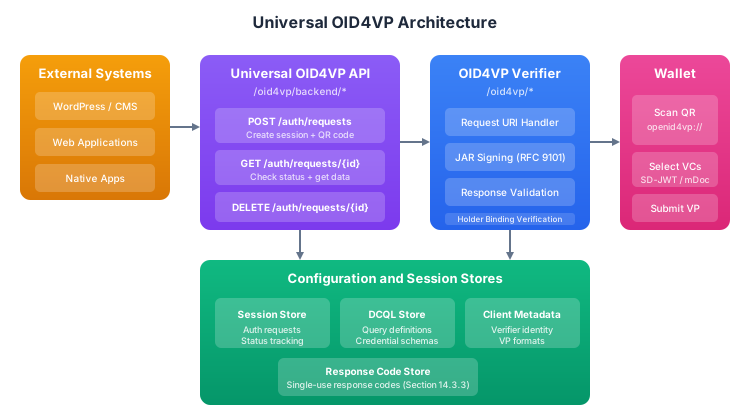
In a typical EDK deployment the verifier service exposes both the OpenID4VP public endpoints (/oid4vp/request-uri/..., /oid4vp/direct_post, optional /oid4vp/backend/auth/requests Universal API) and the DCQL admin surface (/api/v1/oid4vp/dcql/..., /api/services/v1/oid4vp/verifiers/{verifierId}/dcql/...). The admin endpoints write to the versioned DCQL store, which is backed by PostgreSQL or MySQL; the public endpoints resolve DCQL queries through the version-aware DcqlQueryResolver, which checks the verifier binding (if a verifierId is in scope), pulls the pinned version's body, and feeds it into the IDK authorization-request creator.
Where Things Live
| Concern | Module |
|---|---|
| Versioned DCQL store contract + impl | com.sphereon.edk:lib-oid4vp-dcql-store-versioned-public / -impl |
| PostgreSQL DCQL persistence | com.sphereon.edk:lib-oid4vp-dcql-store-versioned-persistence-postgresql |
| MySQL DCQL persistence | com.sphereon.edk:lib-oid4vp-dcql-store-versioned-persistence-mysql |
| DCQL version REST adapter | com.sphereon.edk:lib-oid4vp-dcql-store-versioned-rest |
| Channel-to-DCQL authoring | com.sphereon.edk:lib-semantic-model-public / -verifier-impl / -verifier-rest |
| Verifier-DCQL binding store (VDX) | com.sphereon.vdx:lib-data-store-oid4vp-dcql-binding-public / -service-impl |
| Verifier binding REST adapters | com.sphereon.vdx:lib-data-store-oid4vp-dcql-binding-rest |
| Verifier binding persistence | ...-persistence-postgres / -persistence-mysql |
| Verifier-aware DCQL resolver | com.sphereon.vdx:lib-data-store-oid4vp-dcql-binding-resolver |
| Tenant-path-aware verifier endpoints | com.sphereon.edk:lib-oid4vp-verifier-rest-tenant |
| Routed-command manifests | com.sphereon.edk:lib-oid4vp-{verifier,holder,universal,common}-remote |
| Auth bridge (OID4VP to OAuth2/OIDC) | com.sphereon.edk:lib-oid4vp-auth-bridge-api / -impl |
Next Steps
- Integration: the Universal OID4VP API guide (works against either IDK or EDK verifier stacks)
- DCQL Store: the storage model, the versioning semantics, and how resolution snapshots queries into authorization sessions
- DCQL REST API: every admin and version-history endpoint, with request/response shapes
- DCQL Authoring: derive versioned queries from verifiable-credential channels
- Verifier Bindings: per-verifier DCQL pinning, scheduled activations, REST surface
- Interactive API Docs: full OpenAPI for the OID4VP Verifier API