Version: v0.13
Cedarling Integration
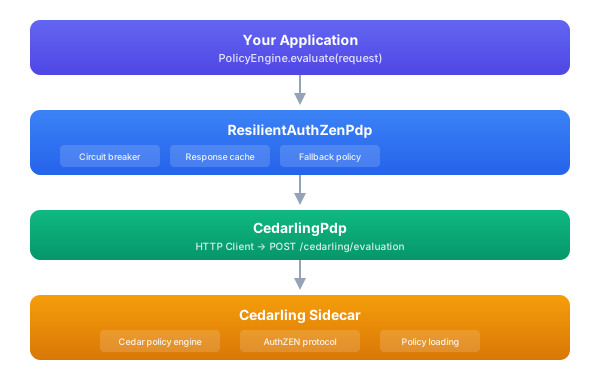
Cedarling is a sidecar that exposes the Cedar policy engine via the OpenID AuthZEN protocol. The EDK provides a dedicated client for Cedarling integration.
Overview
Cedar is a policy language developed by AWS that provides:
- Readable policies - Human-friendly syntax for authorization rules
- Fast evaluation - Millisecond-level decision times
- Formal verification - Policies can be mathematically proven correct
Cedarling wraps Cedar in an AuthZEN-compliant REST API, enabling integration with the EDK's authorization framework.
Architecture
Configuration
CedarlingConfig
data class CedarlingConfig(
    val baseUrl: String,                                    // Cedarling base URL
    val evaluationPath: String = "/cedarling/evaluation",   // Evaluation endpoint
    val healthPath: String = "/health",                     // Health check endpoint
    val discoveryPath: String = "/.well-known/authzen-configuration",
    val evaluationTimeoutMs: Long = 5000,
    val healthCheckTimeoutMs: Long = 2000
)
Factory Methods
// Local development
val localConfig = CedarlingConfig.LOCAL
// Equivalent to: CedarlingConfig(baseUrl = "http://localhost:5000")

// From environment variables
val envConfig = CedarlingConfig.fromEnvironment(
    baseUrl = System.getenv("CEDARLING_URL") ?: "http://localhost:5000",
    evaluationTimeoutMs = 3000
)
Spring Boot Configuration
sphereon:
  authzen:
    enabled: true
    pdp:
      type: cedarling
      base-url: http://cedarling-sidecar:5000
      evaluation-path: /cedarling/evaluation
      health-path: /health
      timeout-ms: 5000
      health-check-timeout-ms: 2000
CedarlingPdp
The Cedarling PDP client implementation:
class CedarlingPdp(
    private val config: CedarlingConfig,
    private val httpClient: HttpClient = createDefaultClient()
) : AuthZenPdp {

    override val id: String = "cedarling"

    override suspend fun isHealthy(): Boolean {
        return try {
            withTimeout(config.healthCheckTimeoutMs) {
                val response = httpClient.get("${config.baseUrl}${config.healthPath}")
                response.status.isSuccess()
            }
        } catch (e: Exception) {
            false
        }
    }

    override suspend fun evaluate(
        request: AuthZenEvaluationRequest
    ): IdkResult<AuthZenEvaluationResponse, IdkError> {
        return try {
            withTimeout(config.evaluationTimeoutMs) {
                val response = httpClient.post("${config.baseUrl}${config.evaluationPath}") {
                    contentType(ContentType.Application.Json)
                    setBody(request)
                }

                if (response.status.isSuccess()) {
                    Ok(response.body<AuthZenEvaluationResponse>())
                } else {
                    Err(IdkError(
                        code = "CEDARLING_PDP_ERROR",
                        message = "PDP returned ${response.status}"
                    ))
                }
            }
        } catch (e: TimeoutCancellationException) {
            Err(IdkError(code = "CEDARLING_TIMEOUT", message = "Request timed out"))
        } catch (e: Exception) {
            Err(IdkError(code = "CEDARLING_ERROR", message = e.message ?: "Unknown error"))
        }
    }
}
Usage Examples
Basic Evaluation
import com.sphereon.authz.authzen.cedarling.CedarlingPdp
import com.sphereon.authz.authzen.cedarling.CedarlingConfig
import com.sphereon.authz.authzen.model.*

val config = CedarlingConfig(baseUrl = "http://localhost:5000")
val pdp = CedarlingPdp(config)

// Check access
val request = AuthZenEvaluationRequest(
    subject = AuthZenSubject.user("alice"),
    action = AuthZenAction(name = "read"),
    resource = AuthZenResource(type = "document", id = "doc-123"),
    context = AuthZenContext(tenantId = "acme", sessionId = "session-abc")
)

val result = pdp.evaluate(request)

when (result) {
    is Ok -> {
        if (result.value.decision) {
            println("Access granted")
        } else {
            println("Access denied")
        }
    }
    is Err -> println("Error: ${result.error.message}")
}
With Resilience
import com.sphereon.authz.authzen.impl.ResilientAuthZenPdp

val resilientPdp = ResilientAuthZenPdp(
    delegate = CedarlingPdp(config),
    config = AuthZenConfig(
        enabled = true,
        fallbackPolicy = FallbackPolicy.DENY,
        cacheEnabled = true,
        cacheTtlSeconds = 300,
        resilience = ResilienceConfig(
            circuitBreakerEnabled = true,
            failureThreshold = 5,
            resetTimeMs = 30000
        )
    )
)

// Evaluate with automatic caching and circuit breaking
val result = resilientPdp.evaluate(request)

// Monitor health
println("Circuit state: ${resilientPdp.getCircuitBreakerState()}")
println("Cache stats: ${resilientPdp.getCacheStats()}")
As PolicyEngine
import com.sphereon.authz.policy.AuthZenPolicyEngine

// Wrap in generic PolicyEngine interface
val policyEngine: PolicyEngine = AuthZenPolicyEngine(resilientPdp)

// Use PolicyRequest instead of AuthZenEvaluationRequest
val policyRequest = PolicyRequest(
    principal = PolicyPrincipal(type = "User", id = "alice"),
    action = PolicyAction(name = "document.read"),
    resource = PolicyResource(type = "Document", id = "doc-123"),
    context = PolicyContext(tenantId = "acme")
)

val decision = policyEngine.evaluate(policyRequest).getOrThrow()

if (decision.isPermitted) {
    // Proceed with operation
}
Cedar Policy Examples
Basic RBAC
// Allow admins to perform any action
permit (
    principal in Role::"admin",
    action,
    resource
);

// Allow users to read their own documents
permit (
    principal,
    action == Action::"read",
    resource
) when {
    resource.owner == principal
};
Tenant Isolation
// Only allow access within same tenant
permit (
    principal,
    action,
    resource
) when {
    principal.tenant_id == resource.tenant_id
};
Command-Based Authorization
// Allow specific command patterns
permit (
    principal in Role::"document-editor",
    action,
    resource
) when {
    action.domain == "document" &&
    action.operation in ["create", "read", "update"]
};

// Deny delete for non-owners
forbid (
    principal,
    action,
    resource
) when {
    action.operation == "delete" &&
    resource.owner != principal
};
Deployment
Docker Compose
services:
  cedarling:
    image: janssenproject/cedarling:latest
    ports:
      - "5000:5000"
    volumes:
      - ./policies:/policies
    environment:
      - CEDAR_POLICY_DIR=/policies

  app:
    build: .
    environment:
      - CEDARLING_URL=http://cedarling:5000
    depends_on:
      - cedarling
Kubernetes
apiVersion: apps/v1
kind: Deployment
metadata:
  name: my-app
spec:
  template:
    spec:
      containers:
        - name: app
          image: my-app:latest
          env:
            - name: CEDARLING_URL
              value: http://localhost:5000

        - name: cedarling
          image: janssenproject/cedarling:latest
          ports:
            - containerPort: 5000
          volumeMounts:
            - name: policies
              mountPath: /policies

      volumes:
        - name: policies
          configMap:
            name: cedar-policies
Error Handling
The Cedarling client uses specific error codes:
| Error Code | Description |
|---|---|
CEDARLING_PDP_ERROR | HTTP error from Cedarling |
CEDARLING_TIMEOUT | Request exceeded timeout |
CEDARLING_ERROR | General communication error |
CEDARLING_DISCOVERY_ERROR | Failed to fetch configuration |
val result = pdp.evaluate(request)

when (result) {
    is Ok -> handleSuccess(result.value)
    is Err -> {
        when (result.error.code) {
            "CEDARLING_TIMEOUT" -> {
                // PDP slow, use cached result or fallback
            }
            "CEDARLING_PDP_ERROR" -> {
                // PDP returned error, check policies
            }
            else -> {
                // Network or other error
            }
        }
    }
}
Health Monitoring
// Check if Cedarling is healthy
val healthy = pdp.isHealthy()

// In Spring Boot, expose as actuator endpoint
@Component
class CedarlingHealthIndicator(
    private val pdp: CedarlingPdp
) : HealthIndicator {

    override fun health(): Health = runBlocking {
        if (pdp.isHealthy()) {
            Health.up().build()
        } else {
            Health.down().withDetail("error", "Cedarling unavailable").build()
        }
    }
}