JWT Validation
The EDK provides framework integrations for JWT validation with support for multiple Identity Providers (IdPs) and per-tenant routing. The core validation logic lives in the IDK, with EDK providing Ktor and Spring Boot integrations.
Overview
The JWT validation framework provides:
- Multi-IdP support - Keycloak, Azure AD, Auth0, Okta, generic OIDC
- Per-tenant routing - Different IdPs per tenant
- Automatic discovery - OIDC discovery for JWKS URIs
- Scope checking - Built-in scope validation helpers
- Framework integration - Ktor plugin and Spring Boot auto-configuration
Architecture
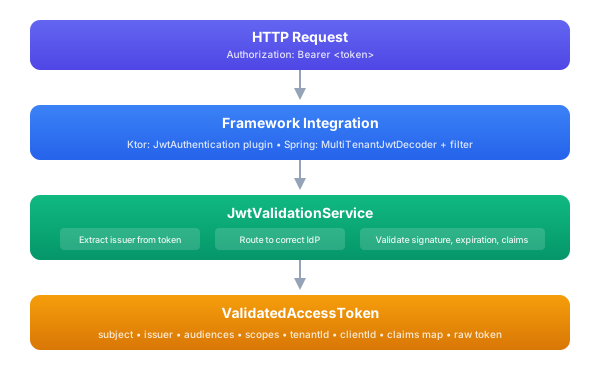
IdP Configuration
Supported IdP Types
| Type | Description |
|---|---|
OIDC | Generic OpenID Connect |
KEYCLOAK | Keycloak with realm support |
AZURE_AD | Azure Active Directory / Entra ID |
AUTH0 | Auth0 |
OKTA | Okta |
CUSTOM | Custom with explicit JWKS URI |
Configuration Examples
// Keycloak
val keycloak = IdpConfig.keycloak(
    id = "keycloak-prod",
    baseUrl = "https://auth.example.com",
    realm = "master",
    audience = "my-api"
)

// Azure AD / Entra ID
val azureAd = IdpConfig.azureAd(
    id = "azure-prod",
    tenantId = "your-azure-tenant-id",
    audience = "api://my-api"
)

// Auth0
val auth0 = IdpConfig.auth0(
    id = "auth0-prod",
    domain = "your-tenant.auth0.com",
    audience = "https://api.example.com"
)

// Generic OIDC (uses discovery)
val oidc = IdpConfig.oidc(
    id = "custom-idp",
    issuer = "https://idp.example.com",
    audience = "my-api"
)

// Custom with explicit JWKS URI
val custom = IdpConfig.custom(
    id = "legacy-idp",
    issuer = "https://legacy.example.com",
    jwksUri = "https://legacy.example.com/.well-known/jwks.json",
    audience = "my-api"
)
IdpConfig Properties
data class IdpConfig(
    val id: String,
    val type: IdpType = IdpType.OIDC,
    val issuer: String,
    val audience: String? = null,
    val jwksUri: String? = null,               // Explicit JWKS URI
    val discoveryUri: String? = null,          // OIDC discovery URL
    val tenantClaim: String = "tenant_id",     // Claim for tenant ID
    val tenantClaimAlternatives: List<String> = listOf("azp", "client_id"),
    val allowedAlgorithms: List<String> = listOf("RS256", "ES256"),
    val clockSkewSeconds: Long = 60,
    val jwksCacheTtlSeconds: Long = 3600,
    val requiredClaims: List<String> = emptyList()
)
ValidatedAccessToken
The result of successful validation:
data class ValidatedAccessToken(
    val subject: String,               // The 'sub' claim
    val issuer: String,                // Verified 'iss' claim
    val audiences: List<String>,       // The 'aud' claim(s)
    val expiresAt: Long,               // Expiration timestamp
    val issuedAt: Long,                // Issued-at timestamp
    val notBefore: Long?,              // Not-before timestamp
    val scopes: Set<String>,           // OAuth scopes
    val tenantId: String?,             // Extracted tenant ID
    val clientId: String?,             // Client ID (azp/client_id)
    val jwtId: String?,                // JWT ID (jti)
    val rawToken: String,              // Original token string
    val claims: Map<String, JsonElement>,  // All claims
    val idpId: String                  // Which IdP validated this
) {
    fun hasScope(scope: String): Boolean = scopes.contains(scope)
    fun hasAllScopes(required: Set<String>): Boolean = scopes.containsAll(required)
    fun hasAnyScope(allowed: Set<String>): Boolean = scopes.any { allowed.contains(it) }
}
Ktor Integration
Plugin Installation
import com.sphereon.oauth2.jwt.validation.ktor.*
import io.ktor.server.application.*

fun Application.module() {
    // Install JWT authentication
    install(JwtAuthentication) {
        validationService = myJwtValidationService

        anonymousConfig = AnonymousAccessConfig(
            allowed = false,
            allowedPaths = listOf("/health", "/api/public/*")
        )

        onAuthenticationFailed = { call, message ->
            call.respond(HttpStatusCode.Unauthorized, mapOf("error" to message))
        }
    }
}
Accessing Validated Token
import com.sphereon.oauth2.jwt.validation.ktor.ValidatedTokenKey

routing {
    get("/protected") {
        val token = call.attributes.getOrNull(ValidatedTokenKey)

        if (token != null) {
            call.respond("Hello ${token.subject}, tenant: ${token.tenantId}")
        } else {
            call.respond(HttpStatusCode.Unauthorized)
        }
    }

    get("/admin") {
        val token = call.attributes[ValidatedTokenKey]

        if (token.hasScope("admin")) {
            call.respond("Admin access granted")
        } else {
            call.respond(HttpStatusCode.Forbidden, "Requires admin scope")
        }
    }
}
Tenant and Principal Resolution
import com.sphereon.oauth2.jwt.validation.ktor.*

fun Application.module() {
    install(JwtAuthentication) { ... }

    // Use JWT-based resolvers for user context
    install(KotlinInjectPlugin) {
        appComponent = myAppComponent
        tenantResolver = ValidatingTenantResolver(defaultTenantId = "default")
        principalResolver = ValidatingPrincipalResolver()
    }
}
Spring Boot Integration
Configuration
sphereon:
  auth:
    jwt:
      enabled: true

      default-idp:
        issuer: https://auth.example.com/realms/master
        audience: my-api
        tenant-claim: tenant_id

      tenant-idps:
        tenant-a:
          issuer: https://login.microsoftonline.com/tenant-a-id/v2.0
          type: AZURE_AD
          tenant-claim: tid
        tenant-b:
          issuer: https://tenant-b.auth0.com/
          type: AUTH0
          audience: api://tenant-b

      anonymous:
        allowed: false
        allowed-paths:
          - /health
          - /actuator/**
          - /.well-known/**
Properties Reference
@ConfigurationProperties(prefix = "sphereon.auth.jwt")
class JwtValidationProperties {
    var enabled: Boolean = true
    var defaultIdp: IdpProperties = IdpProperties()
    var tenantIdps: Map<String, IdpProperties> = emptyMap()
    var anonymous: AnonymousProperties = AnonymousProperties()

    class IdpProperties {
        var type: IdpType = IdpType.OIDC
        var issuer: String = ""
        var audience: String? = null
        var jwksUri: String? = null
        var tenantClaim: String = "tenant_id"
        var tenantClaimAlternatives: List<String> = listOf("azp", "client_id")
        var allowedAlgorithms: List<String> = listOf("RS256", "ES256")
        var jwksCacheTtlSeconds: Long = 3600
        var clockSkewSeconds: Long = 60
        var requireExp: Boolean = true
        var requireIat: Boolean = false
    }

    class AnonymousProperties {
        var allowed: Boolean = false
        var allowedPaths: List<String> = listOf("/health", "/actuator/**")
    }
}
Controller Usage
import com.sphereon.oauth2.jwt.validation.spring.ValidatingAuthenticationResolver
import org.springframework.web.bind.annotation.*
import jakarta.servlet.http.HttpServletRequest

@RestController
@RequestMapping("/api")
class MyController(
    private val authResolver: ValidatingAuthenticationResolver
) {

    @GetMapping("/profile")
    fun getProfile(request: HttpServletRequest): Map<String, Any> {
        val token = authResolver.requireValidatedToken(request)

        return mapOf(
            "subject" to token.subject,
            "tenant" to (token.tenantId ?: "unknown"),
            "scopes" to token.scopes,
            "expires_at" to token.expiresAt
        )
    }

    @PostMapping("/admin/action")
    fun adminAction(request: HttpServletRequest): ResponseEntity<Any> {
        if (!authResolver.hasScope(request, "admin")) {
            return ResponseEntity.status(403)
                .body(mapOf("error" to "Requires admin scope"))
        }

        return ResponseEntity.ok(mapOf("result" to "success"))
    }

    @GetMapping("/resources")
    fun getResources(request: HttpServletRequest): ResponseEntity<Any> {
        val requiredScopes = setOf("read:resources", "list:resources")

        if (!authResolver.hasAnyScope(request, *requiredScopes.toTypedArray())) {
            return ResponseEntity.status(403)
                .body(mapOf("error" to "Insufficient scopes"))
        }

        val tenantId = authResolver.resolveTenantId(request)
        return ResponseEntity.ok(getResourcesForTenant(tenantId))
    }
}
Token Forwarding
Forward tokens to downstream services:
@Service
class DownstreamClient(
    private val authResolver: ValidatingAuthenticationResolver,
    private val restTemplate: RestTemplate
) {

    fun callDownstream(request: HttpServletRequest): String {
        val rawToken = authResolver.getRawToken(request)
            ?: throw UnauthorizedException("No token")

        val headers = HttpHeaders().apply {
            setBearerAuth(rawToken)
        }

        val entity = HttpEntity<Void>(headers)
        return restTemplate.exchange(
            "http://downstream/api/resource",
            HttpMethod.GET,
            entity,
            String::class.java
        ).body ?: ""
    }
}
Multi-Tenant JWT Decoder
The Spring integration includes a multi-tenant decoder that routes to the correct IdP based on token issuer:
class MultiTenantJwtDecoder(
    private val defaultIdpConfig: IdpConfig,
    private val tenantIdpConfigs: Map<String, IdpConfig>
) : JwtDecoder {

    override fun decode(token: String): Jwt {
        // Extract issuer from unverified token
        val issuer = extractIssuerFromToken(token)
            ?: throw JwtException("Cannot extract issuer")

        // Get or create decoder for this issuer
        val decoder = getOrCreateDecoder(issuer)

        // Decode and validate
        return decoder.decode(token)
    }

    // Register new IdP at runtime
    fun registerIdp(config: IdpConfig)

    // Remove IdP
    fun removeIdp(issuer: String)

    // Clear decoder cache (for key rotation)
    fun clearCache()
}
Error Handling
Error Types
enum class JwtValidationErrorType {
    MISSING_TOKEN,
    INVALID_TOKEN_FORMAT,
    SIGNATURE_INVALID,
    TOKEN_EXPIRED,
    TOKEN_NOT_YET_VALID,
    UNTRUSTED_ISSUER,
    INVALID_AUDIENCE,
    MISSING_REQUIRED_CLAIM,
    JWKS_UNAVAILABLE,
    KEY_NOT_FOUND,
    ALGORITHM_NOT_ALLOWED,
    IDP_CONFIGURATION_ERROR,
    DISCOVERY_FAILED,
    VALIDATION_ERROR
}
Error Response
data class JwtValidationError(
    val type: JwtValidationErrorType,
    val message: String,
    val issuer: String? = null,
    val audience: String? = null,
    val claim: String? = null,
    val cause: String? = null
)
Integration with AuthZEN
Forward validated tokens to the PDP for fine-grained authorization:
@Service
class AuthorizedService(
    private val authResolver: ValidatingAuthenticationResolver,
    private val policyEngine: PolicyEngine
) {

    suspend fun performAction(request: HttpServletRequest, resourceId: String) {
        val token = authResolver.requireValidatedToken(request)

        // Build policy request with token info
        val policyRequest = PolicyRequest(
            principal = PolicyPrincipal(
                type = "User",
                id = token.subject,
                attributes = mapOf(
                    "jwt" to JsonPrimitive(token.rawToken),
                    "scopes" to JsonArray(token.scopes.map { JsonPrimitive(it) })
                )
            ),
            action = PolicyAction(name = "resource.read"),
            resource = PolicyResource(type = "Resource", id = resourceId),
            context = PolicyContext(
                tenantId = token.tenantId,
                accessToken = token.rawToken
            )
        )

        val decision = policyEngine.evaluate(policyRequest).getOrThrow()

        if (decision.isDenied) {
            throw ForbiddenException("Access denied")
        }

        // Proceed with action
    }
}
Security Best Practices
Always validate audience - Configure expected audience to prevent token confusion attacks.
Use short clock skew - Keep clockSkewSeconds minimal (30-60s) for accurate expiration.
Cache JWKS appropriately - Balance between security (shorter TTL) and performance (longer TTL).
Restrict algorithms - Only allow expected algorithms (RS256, ES256) to prevent algorithm confusion.
Validate required claims - Use requiredClaims for critical claims like tenant_id.
Use TLS everywhere - Protect tokens in transit between services.